
Buzz Cybersecurity: from page two to the top of the map in two markets
The situation
Buzz Cybersecurity runs two offices, one in Irvine and one in Corona. Same company, same name, two search markets about thirty miles apart. On the 91 at five o'clock, that is not thirty minutes.
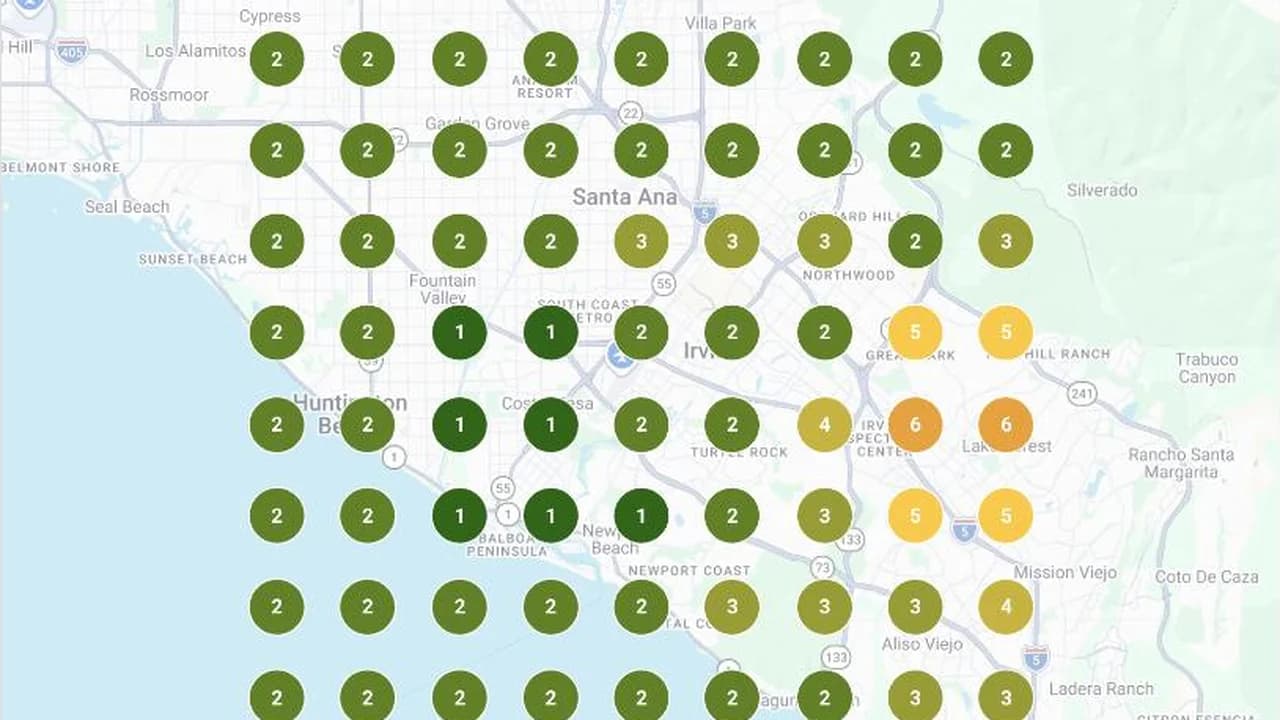
Edward, the founder, has known Matt for more than 13 years. When the SEO program started in October 2025, the company was not invisible. It was worse than that in a way most owners never see: it was mid-table. Our first grid scan put the average map position across Irvine at 5.0 for the firm's core search, showing in the top three across roughly half the city. Good enough to feel fine. Not good enough to get the call.
Outside Irvine it fell apart. County-wide, the average position was 9.6 with a share of local voice under 5 percent, which means that across a grid of Orange County search points, the business surfaced in the top three at almost none of them. For the firm's second service line in Irvine, it did not rank at all. Corona was not being measured yet.
That is the honest starting line. A single rank check from the office would have shown something decent, because a rank check from the office is a check from the one spot where proximity does all the work.
What we built
We started by measuring the thing properly. Every market gets a grid scan, not a rank check: a lattice of search points across the city, each one asking Google the question a real buyer standing there would ask. That produces two numbers we track monthly. Average rank position across the grid, and share of local voice, the share of those points where the business lands in the top three.
Then the structural work, in this order:
Both Google Business Profiles were treated as separate businesses rather than as one company with a second address. Correct coordinates per office, its own landing page, its own service areas, and structured data stitching the two profiles to one parent brand so they reinforce each other instead of competing.
Each office got pages for the cities it can actually serve, written for that city, instead of one service area page trying to cover everywhere.
In August 2026 we replaced the old WordPress site on shared hosting with a static build on Vercel: a lean set of service pages, a locations section for the cities the team actually drives to, the blog archive, and the usual company pages. Faster, cheaper to run, and no plugin surface to babysit.
Then we tightened the structure: a locations hub in the navigation, county pages that carry the proof, and city pages that link up and sideways so a visitor can browse to every one of them.
The pages we deleted mattered as much as the pages we added. That is the part of this work nobody sells.
What moved
Ten months of scans, October 2025 to August 2026:
In Irvine, the average map position for the firm's core search went from 5.0 to 2.2, and share of local voice from 52 percent to 91 percent. Its second service line went from unranked to an average of 4.9, showing in the top three across 36 percent of the city where the number used to be zero.
County-wide is the bigger story. Average position across Orange County went from 9.6 to 3.4, and share of local voice from 5 percent to 67 percent. That is the difference between a firm that gets found by people who already drive past the office and one that gets found across a county of 3.1 million people.
Corona came online in February 2026 and took six months to top out. Average position for its managed IT searches went from 3.3 to 1.0, with 100 percent share of local voice. Riverside County went from unranked to an average of 3.8.
Organic search followed. Clicks doubled between January and May 2026, and the pages doing the work are the ones a buyer lands on before a call, not the trivia posts.
What this means for a service business
Three things carry over to any local service business with more than one office.
Measure across the map, not from your desk. Almost every owner who tells us they rank fine is checking from inside their own building. Proximity is doing the work, not the marketing.
A second location is a second business in Google's eyes, and it has to be built like one. One profile, one page, one set of reviews, one set of directory records per office. Pooling them keeps the satellite invisible.
Getting to the top of the map is slower than any pitch admits and then holds longer than any ad. Irvine took ten months. Corona took six. Neither has slipped.
Where this leaves us
Buzz is still on the program. The next phase is paid search running alongside the map results, on the same measurement discipline.
If you run a service business with one or two locations and you want to know what your market actually looks like from your customer's driveway rather than from your desk, we will scan it and show you. No obligation. Just clarity on where you stand.