
On this page
- We are filing a DBA before we rename a single Google profile
- Fifteen city pages, not ninety, because of one paragraph in the spam policies
- Ten months of the boring version, measured on a grid
- The reviews conversation is the shortest one we have
- People-first is a claim you can check
- What actually gets a local business cited by ChatGPT, Gemini and AI Overviews
- Who we turn away
I have been doing digital marketing since May 2011. Fifteen years. Most of what I have watched local businesses get sold in that time is a version of local SEO that Google says, in writing, on a public page, that it does not want.
The rules are not hidden. Google publishes its spam policies, its Business Profile guidelines and its position on AI search at URLs anyone can read on a Tuesday afternoon. Very few people in this business have read them. Most have read a summary of a summary from someone selling a course.
This is how we run local SEO at BrandFamous, tied to the policy text, plus what we turned down while doing it.
We are filing a DBA before we rename a single Google profile
Our Google Business Profile is moving to Irvine this month. Before we touch the name field, we are filing a fictitious business name with the Orange County Clerk-Recorder: BrandFamous Marketing & Web Design.
Here is why that order matters. Google's guidelines for representing your business tell you to "Represent your business as it's consistently represented and recognized in the real world across signage, stationery, and other branding." The same page tells you not to add marketing taglines, hours or keywords to the name.
Everyone in local SEO knows a profile name containing what people search performs better in the map pack. The lazy version is to type keywords into the box on a name you use nowhere else. The honest version is to go be named that. Once the DBA is filed, it is the real-world name, and it goes on the invoices, the email signature, the site header, the business cards Google asks to see during video verification, and every directory listing, character for character.
The trade-off is real and I will name it. Doing it properly costs a county filing, four weeks of newspaper notices, and the conversion of our LLC from Florida to California that we finished in July. Typing it into the box takes nine seconds. One of those produces a name. The other produces a claim.
The address is the same kind of decision. We hold a suite on Main Street in Irvine for legal mail. It is not going on the profile, because nobody is served there. Google's service area guidance is plain about it: "If you don't serve customers at your business address, remove your address from your Business Profile." So the profile runs as a service-area business with the address hidden and up to 20 service areas listed, which Google holds to roughly a two hour drive radius.
Phoenix sits outside that radius, so it earns its own profile at a real staffed location or it ranks through content and nothing else.
What we refuse: renting a mailbox in six cities and planting six pins. It works, right up until a competitor reports it. Then the pins come down, the profile gets suspended, and the client has no fallback and no history.
Fifteen city pages, not ninety, because of one paragraph in the spam policies
Our backlog has 90 city pages in it across Orange County, Los Angeles County and the Phoenix metro. We are launching 15.
The reason is on Google's spam policies page, under doorway abuse: "Doorway abuse is when sites or pages are created to rank for specific, similar search queries. They lead users to intermediate pages that aren't as useful as the final destination." One of the characteristics Google lists by name is "having multiple domain names or pages targeted at specific regions or cities that funnel users to one page."
That is a precise description of how most agencies build city pages. Same 700 words, city name swapped, every page pushing the reader back to the homepage.
The next policy down is scaled content abuse: "Scaled content abuse is when many pages are generated for the primary purpose of manipulating search rankings and not helping users." Volume is the tell. Not the tool that produced it.
So we set a gate instead of a launch date. Fifteen pages go live behind three rings: Orange County, the Inland Empire and Arizona. Then we sit in Search Console for four to six weeks. Passing means all 15 indexed with no "Crawled, currently not indexed" or "Duplicate" flags, impressions climbing week over week, at least three pages inside the top 20 for a city query, and zero manual actions. Wave 2 opens on that evidence or it does not open.
Each of those 15 has to carry four things no template can fake: a real proof block from work we did, a sourced local data point, an FAQ answer that would look wrong on a competitor's site, and a sentence saying who we turn away in that market. Then a five word overlap check runs across every page, and any repeat outside our brand phrases sends it back.
Delete the city name from a paragraph. If the paragraph is still true, the paragraph does not ship.
The same policy page covers site reputation abuse, which is third-party content published on a host site "mainly because of that host's already-established ranking signals." We do not sell space on our domain for that reason, and we will not park a client's content on a borrowed domain to rent its authority.
Ten months of the boring version, measured on a grid
Buzz Cybersecurity is an IT and security company with offices in Irvine and Corona. We have run their local SEO since October 2025.
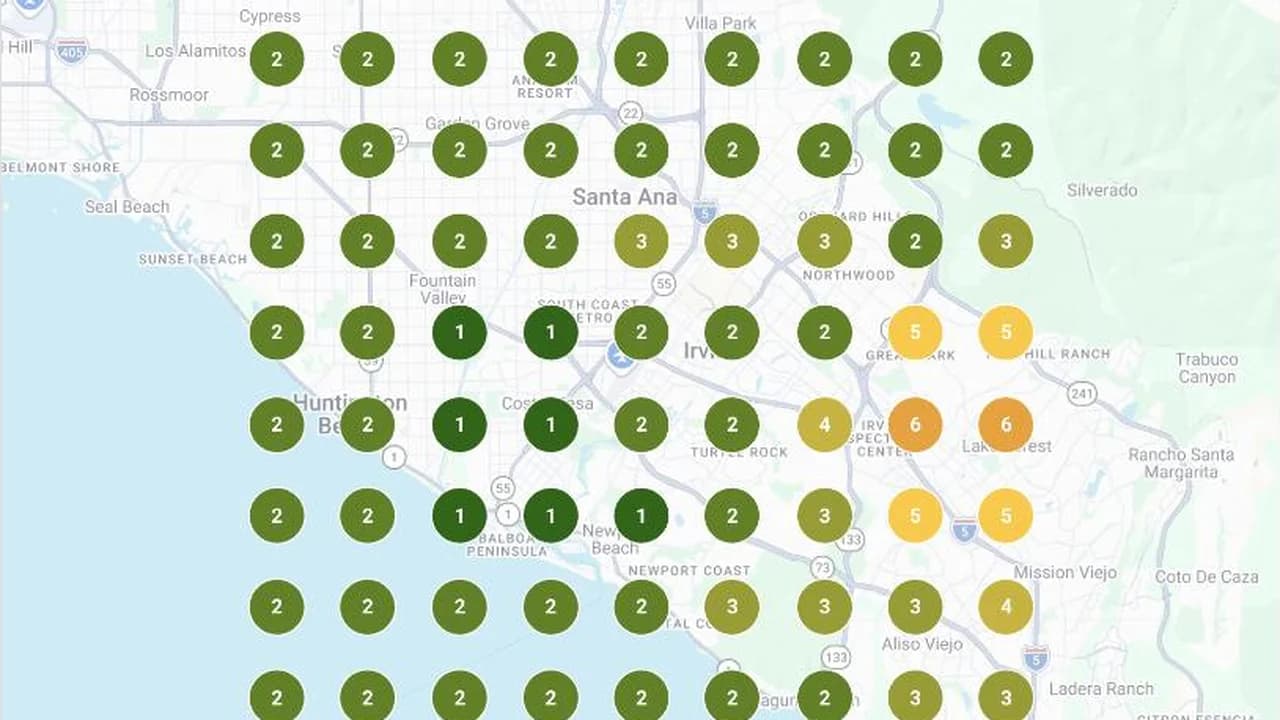
We measure it with grid scans, because a single rank number in local search is close to meaningless. A grid scan drops a lattice of points across the city, checks the map pack position at each point, and reports two figures: average rank position, and share of local voice, which is how much of the visible map pack the business holds. An unranked point counts as 21.
In Irvine, between the first scan on 13 October 2025 and the latest on 17 August 2026:
- Average map position on their core searches went from 5.03 to 2.16.
- Share of local voice went from 51.9 percent to 91.4 percent.
- Their managed IT searches went from unranked, 0 percent share, to an average of 4.87 and 35.8 percent.
The Corona office started later, February 2026, and moved faster because the market is thinner:
- Average map position on managed IT searches went from 3.33 to 1.00.
- Share of local voice went from 40.7 percent to 100 percent.
- Across Riverside County, managed IT went from unranked to an average of 3.83 and 56.8 percent share.
Nothing in that program is clever. One name used identically everywhere. Two offices, two profiles, real staff at each, non-overlapping service areas. Service pages that match what they actually sell rather than what has search volume. Reviews requested consistently instead of in bursts.
Here is the part an agency case study usually leaves out. Their organic clicks doubled from January to May 2026, then fell through the summer. The drop was almost entirely on two informational blog posts, not the service pages that produce calls. I would take that trade, and I would rather tell you than show you a chart cropped at May.
The reviews conversation is the shortest one we have
Google's Maps content policy says "Fake engagement is not allowed and will be removed," and it specifically prohibits merchants offering "payment, discounts, free goods and/or services - in exchange for posting any review or revision or removal of a negative review." The same policy flags content based on a conflict of interest, including "current or former employment."
So: no purchased reviews. No gift card for five stars. No staff reviews from a phone in the break room. And no review gating, which is the polite one, where you survey customers first and only route the happy ones to Google.
What we do instead takes about a minute per customer. Ask everyone, right after the work is finished, with a short link. Answer every review, including the ones that sting. A business with years of real reviews, a few of them honestly mediocre, survives a policy sweep. A wall of uniformly perfect reviews collected in one month does not.
People-first is a claim you can check
Google's helpful content guidance is a list of questions, not a formula. The one that decides most of our editing is this: "Does the content clearly demonstrate first-hand expertise and a depth of knowledge (for example, expertise that comes from having actually used a product or service, or visiting a place)?"
Underneath it sits Google's who, how and why framing. Who wrote this, how was it made, why does it exist. My name is on this page because I wrote it and I will answer for the numbers in it. Every city page we publish carries the same byline.
We do not fake the human tells either. No invented anecdotes about walking into a client's office, no manufactured typos to look less polished, no quotes from a "local business owner" who does not exist. Fabricated experience is worse than thin content, and it is lying to a reader.
What actually gets a local business cited by ChatGPT, Gemini and AI Overviews
Start with what Google published on its own AI features page: "There are no additional requirements to appear in AI Overviews or AI Mode, nor other special optimizations necessary." And: "You don't need to create new machine readable files, AI text files, or markup to appear in these features. There's also no special schema.org structured data that you need to add."
Read that twice before you buy an AI SEO package built around a special file or a magic schema block. There is no such product. We will not sell one.
What does appear to matter, from what we can observe across client profiles, is unglamorous. Entity consistency first: one name, one number, one address treatment across the profile, the site and every directory, so a model resolves you to a single business rather than three fuzzy ones. Then third-party description, because a model repeats what other sources say about you more readily than what you say about yourself. Then review text, which is often the only place a service and a city appear in the same human sentence.
Our honest limitation: this is not measurable the way the map pack is measurable. There is no stable rank tracker for a chat answer. We watch branded search volume, referral sessions from chat products, and a fixed list of buyer prompts we run by hand once a month and log. Anyone quoting a precise AI visibility percentage is estimating and calling it a measurement. Our AI search work is scoped on that honesty.
Who we turn away
Three kinds of business, consistently.
The one that wants top three in 30 days. The only methods that fast are the ones on the policy pages above, and I am not risking a client's profile to hit an arbitrary deadline.
The one that will not answer the phone. Local SEO produces calls. If those calls go to voicemail on a Tuesday at 2pm, the ranking is a receipt for money that did not turn into work.
The one that wants pins in cities where nobody works. We will build a page for a market you genuinely serve and drive to, not a presence in a city you have never been.
The slow version is genuinely slower. Irvine took ten months to go from a 5.03 average to 2.16. It also survives. Nothing above depends on a loophole staying open.
If you want a read on how this would run in your market, tell us what is not working. We reply the same business day, and the first conversation is where you actually stand, not a pitch.